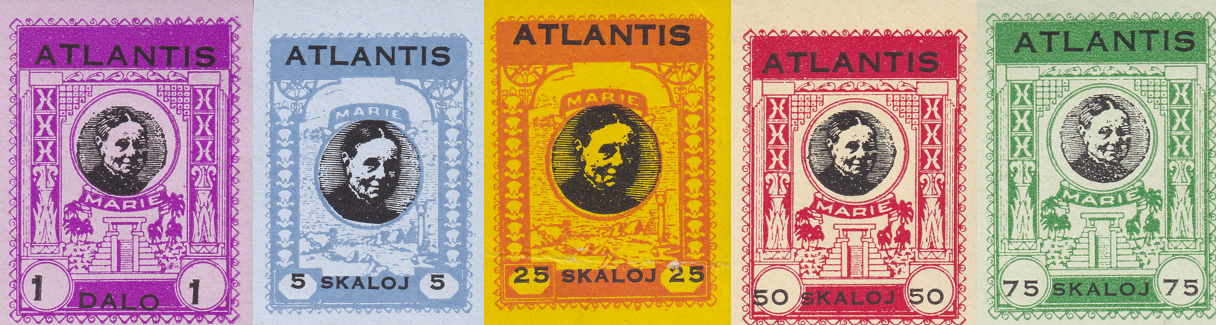
Image: “Princess Marie” stamp series – private collection of V. Schicker
An unexpected letter sent in 1934 to the UPU International Bureau raised an unusual request: membership for the self-proclaimed “Principality of Atlantis.” This historical piece retraces J. L. Mott’s attempt to establish a new state and join the global postal community, revealing a remarkable episode at the crossroads of diplomacy, myth and philately.
“I am writing in [sic] behalf of a group asking what qualifications are necessary to become a member of the Universal Postal Union. We have explored certain little islands east and west of the Istmus [sic] of Panama. […] we claim them as remnants of Atlantis. […] We have organized under the name of Principality of Atlantis, acclaimed a leader and have now about 25 000 backers including prominent men.”Thus read a letter sent from New York on 5 March 1934 by J. L. Mott, addressed to the Universal Postal Union (UPU) International Bureau. Having emigrated from Denmark to the United States of America, Mott’s unique endeavour saw him attempt to form his own country and government by laying claim to the supposed ruins of the sunken city of Atlantis, once described by Plato. While the UPU has archives documenting this episode, additional research was needed to complete the puzzle which we can present in this article. According to available sources, its capital “Odino” was established on an unnamed island off the coast of Haiti, less than 480 km (300 miles) from Miami, Nassau and Havana. However, Mott claimed yet more territories: 14 islands dotted across the Pacific, Caribbean and Atlantic. Today, it seems that these islands were, at best, misidentified but much more likely invented: “Halcyon”, at 640 km (400 miles) south-west of California, could in fact be one of the Revillagigedo Islands; two islands off the Yucatán Peninsula are also mentioned; as are three islands near Cabo Verde.
At the time, requests for admission to the UPU were addressed to the Swiss Federal Council, which ruled on their validity and notified Union members accordingly. In this way, the Swiss diplomatic mission to Washington D.C. found itself tasked with investigating this new principality, as well as leading inquiries into Mott himself. In response, Mott furnished a series of documents, including a one-page constitution that concluded with “Free press and speech and fair play” and revealed his project for steamboat routes from Florida, Cuba and the Bahamas. His ambition was to create in this principality “subject only to the elements of Neptune” a place where tourists, explorers, scientists, artists and traders were welcome. Through the fictitious Goodwill Island, he promised a trading post exempt from all taxes, as well as exhibitions and international fairs where inventions, discoveries from expeditions and works from the world over could be displayed.
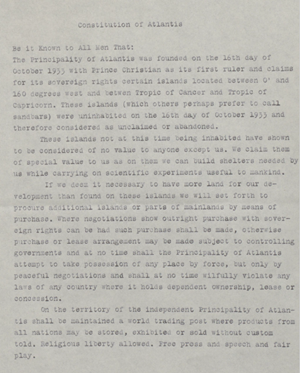
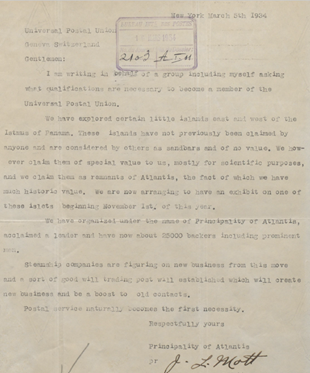
Image: (top left) Constitution of Atlantis Image: (bottom right) Original letter of application from J.L. Mott
The facade soon crumbled and exposed an implausible idea of a libertarian utopia. It was hard to lend it much credence and indeed, through the diplomatic mission’s investigation, it came to light that the New York address was nothing more than a rented office that stood empty, whose landlord had barely ever met Mott. When he turned up in person, discussions quickly revealed that the figure of 25,000 backers was far from the truth (closer to less than a thousand). Moreover, the companies preparing the routes from Florida and Cuba turned out to be ... a single sailing boat owned by Mott, which was not even seaworthy. Although he did not come across as a fraudster (on the contrary, he seemed convinced of the legitimacy of his endeavour, and indeed most of the funds invested were from his personal or family fortune), these discoveries brought his mental state into question during the interviews – on top of the very idea of discovering Atlantis on these isolated, unnamed islands. Mott thus saw his application rejected.
Yet, he did not lose faith and in 1936, he contacted the Swiss consulate in New Orleans, this time offering new elements to support his request. Not only did he arrive in a car registered in the Principality of Atlantis and authorized to drive on US territory, he also presented the consulate with a passport issued by the principality and stamped by South American consulates (to the great surprise of the Swiss Vice-Consul in New Orleans). He also offered coins and stamps destined for use in the principality. Although considered “cinderella stamps”, the Atlantis issues are no less worthy of interest, and not just among philatelists. It would seem that two designs were created, both bearing the name “Atlantis”: a series of rectangular stamps with the effigy of “Princess Marie” against a background of ruins and featuring compass roses in the upper corners; as well as an inverted triangle-shaped stamp depicting either Poseidon or “Prince Christen” at the centre of a gear wheel below crowned wings, with the Atlantis motto written in Esperanto: “Serĉ, Kredi, Vidi” (explore, believe, see). Princess Marie was most probably Mott’s mother, and it is not impossible that the other design therefore portrays his father as Prince Christen, with the features of the Greek god of the sea. The stamps show a monetary unit of “skaloj”, with 100 skaloj equating to 1 “Dalo”.
Despite these new elements, the Principality of Atlantis was once again refused membership of the UPU and the International Telecommunication Union, sounding the death knell of the utopia that could have existed in the middle of the Caribbean or – as Mott put it – between 0° and 160° West and the Tropics of Cancer and Capricorn.
[UPU Archives – Atlantis, 1934]