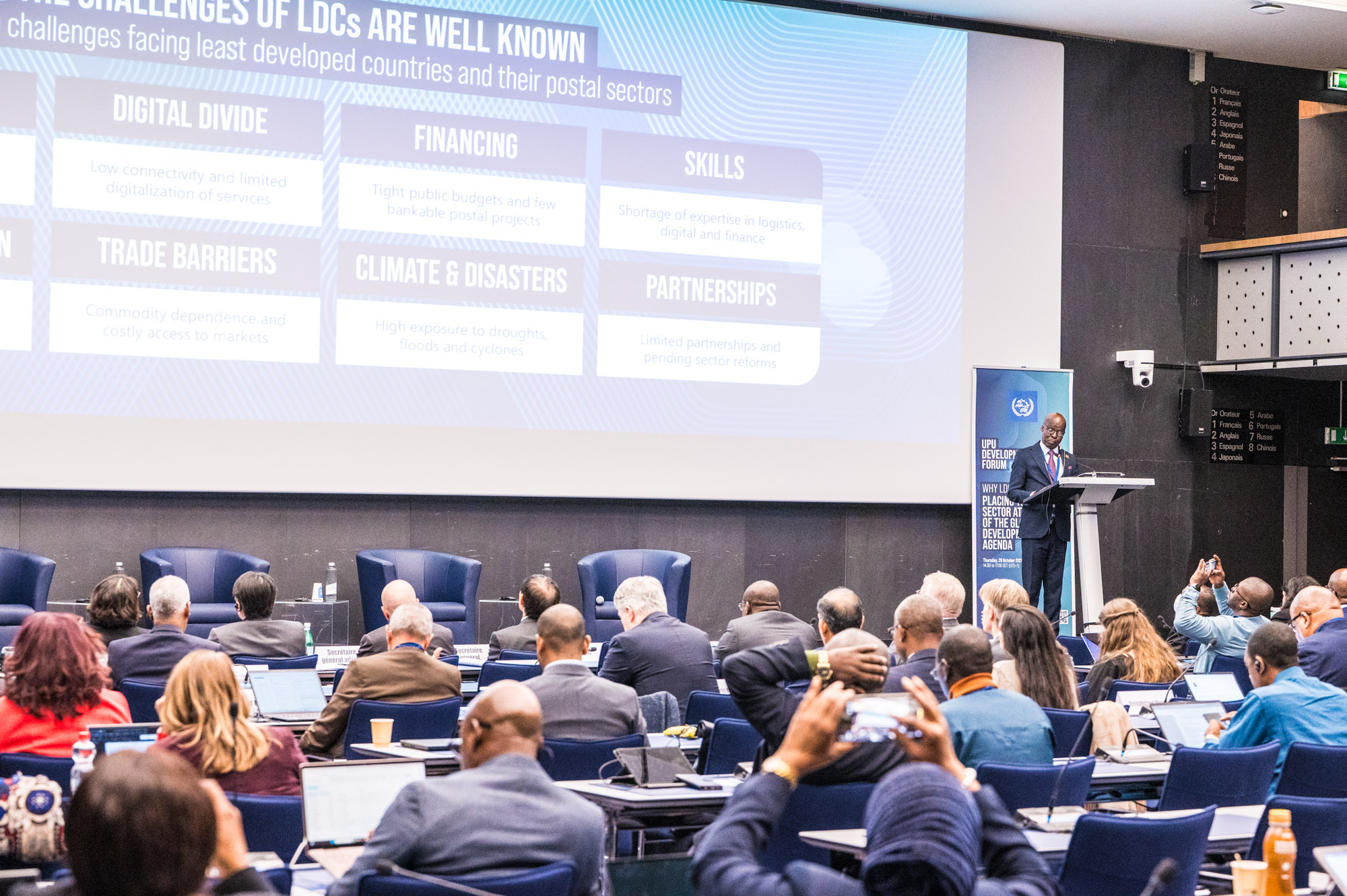
Postal networks reach communities that many other services cannot. Yet in some of the world’s most vulnerable countries, their potential remains largely untapped. How can this extensive infrastructure become a stronger driver of economic and social development? This question brought together representatives of governments, postal leaders, international organizations and development partners for the inaugural UPU Development Forum, held on 29 October 2026 in Berne, Switzerland.
Focusing on least developed countries (LDCs), the forum marked a shift from discussing familiar challenges to identifying practical solutions, partnerships and investment opportunities. Opening the event, Masahiko Metoki, UPU Director General, emphasized that stronger postal networks create opportunities beyond traditional services. “When we strengthen the Post, we create new opportunities. We support small businesses, we improve inclusion and we help communities to participate fully in the wider economy,” he said. Marjan Osvald, UPU Deputy Director General, outlined why a dedicated development forum was needed; while operational and regulatory issues have established platforms within the Union, development cooperation has lacked a comparable high-level space.
Moderated by Kennedy Dewera, Director of Universal Service Fund, Postal and Courier Services at the Postal and Telecommunications Regulatory Authority of Zimbabwe, the discussions brought together diverse perspectives on how to turn postal development challenges into practical opportunities. A central message emerged throughout the discussions: postal networks are not simply service providers, but valuable national infrastructure that can support economic and social development. In his keynote address, Roland Mollerus, Acting UN High Representative for Least Developed Countries, Landlocked Developing Countries and Small Island Developing States, identified three priorities: connectivity, inclusion and resilience. He urged governments to integrate postal development into national strategies rather than treating it as an isolated sector. Political recognition was also a recurring concern among panellists.
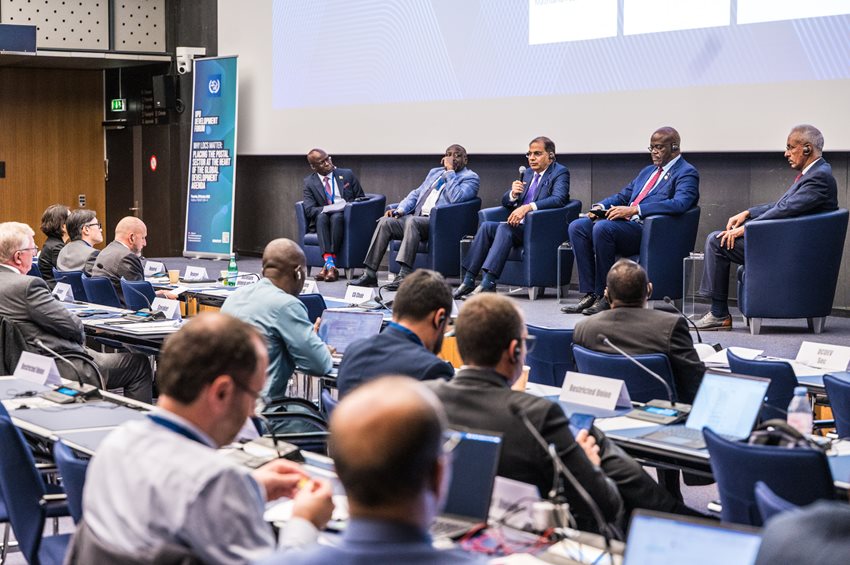
Dr Sifundo Chief Moyo, Secretary General of the Pan African Postal Union, highlighted the opportunities offered by the African Continental Free Trade Area, diaspora remittances and the continent’s large SME sector, challenging postal operators to capture a greater share of these markets through logistics and financial services. George William Nyombi Thembo, Executive Director of the Uganda Communications Commission, offered a different perspective: before attracting resources, postal services must first attract the attention of decision makers. He highlighted Uganda’s efforts to bring the sector into national budget discussions and suggested using post offices as digital access centres, training spaces and hubs for young entrepreneurs.
However, government recognition must also be earned through results. Ould Issa, Director General of Mauritania Post, described how his organization took the initiative to rebuild trust, improve performance and demonstrate its ability to deliver public services rather than waiting for government funding. His experience reinforced an important lesson, namely that postal operators can strengthen their position by demonstrating their value to both governments and communities.
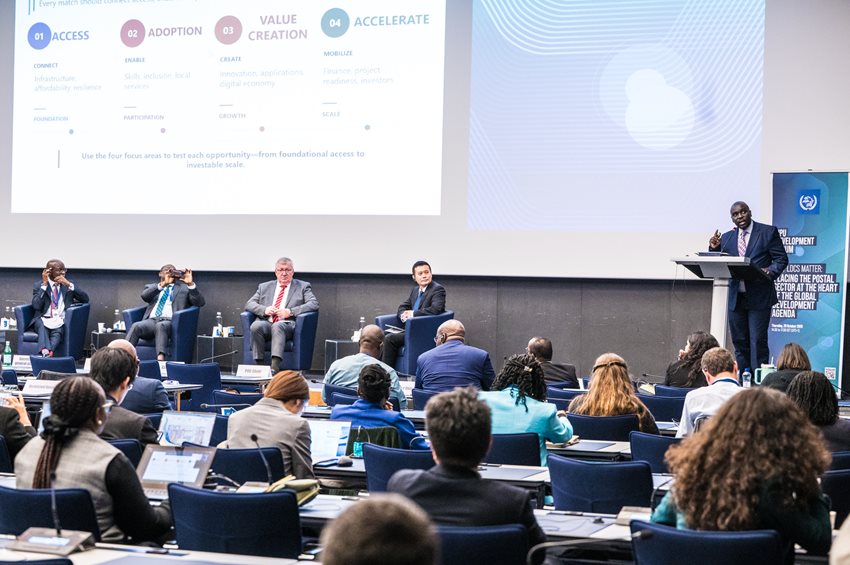
While the needs of LDCs are well documented, securing financing remains a major challenge. Tontama Charles Millogo, Head of Digital Economy at the West African Development Bank, outlined the bank’s ambition to direct 20–30% of its planned investment of 650 billion CFA for digital development towards the postal sector. He stressed that attracting such financing requires technically sound and economically viable projects with clear arrangements for long-term sustainability.
Financial inclusion offered another promising opportunity. Stefan Henkelmann, Head of Division – Africa at the German Sparkassenstiftung for International Cooperation, drew on Germany’s savings bank model, whereby institutions share a common banking technology provider, to suggest that postal operators could adopt similar arrangements rather than developing expensive systems independently. Celine Bacrot, Economist at the United Nations Conference on Trade and Development (UNCTAD), highlighted the importance of including postal services in national e-commerce and trade facilitation strategies. As essential links in the delivery chain, postal operators can help small businesses reach customers and participate in international trade.
Another recurring theme was the value of sharing expertise and adapting successful approaches to local needs. Dr Vinaya Prakash Singh, Secretary General of the Asian-Pacific Postal Union, described practical assistance provided to LDCs through equipment, infrastructure support and targeted training. He also highlighted the importance of disaster preparedness, observing that post offices are often among the last public services to close and the first to reopen when disasters strike. Xiaoming Wu, Deputy Director General at the State Post Bureau of China, reported that more than 800 participants from 72 countries had benefited from over 20 international training programmes organized by China since 2013.
Looking beyond dialogue, Lacina Koné, Director General and CEO of Smart Africa, proposed a joint initiative with the UPU to develop pilot projects connecting postal networks with digital public services, e-commerce and financial inclusion in African LDCs. Paul Kasera Demba of the International Telecommunication Union introduced the Partner2Connect Digital Coalition, which has attracted more than 122 billion USD in estimated commitments towards digital connectivity. These initiatives illustrate how partnerships and shared priorities can help to mobilize resources and translate development ambitions into practical cooperation.
Taken together, the discussions pointed to a change in how postal development should be approached. Rather than viewing postal operators primarily as institutions requiring assistance, participants explored how their networks could become strategic assets for national development.
Closing the forum, Marjan Osvald, UPU Deputy Director General, emphasized the importance of translating discussions into concrete results. “The true measure of this forum will not be what we have said today, but what we achieve together tomorrow,” he said.
The examples shared in Berne showed that solutions already exist, financing opportunities are emerging and experience can be transferred across regions. The challenge lies in bringing these elements together through stronger political commitment, well-prepared projects and sustained cooperation. For LDCs, the stakes extend far beyond the postal sector. Modern postal networks can connect small businesses to new markets, bring financial services to underserved communities and maintain essential services during crises. The opportunity is not simply to modernize postal services, but to use their reach to create economic and social opportunities where they are needed most.
Explore highlights from the Forum in photos on: UPU Flickr