The Universal Postal Union has officially launched ORE Plus, its most ambitious operational readiness programme to date, building on nearly a decade of targeted support to help postal operators worldwide handle the growing demands of cross-border e-commerce.
Running from 2026 to 2029, ORE Plus follows three previous programme cycles and represents a significant expansion in scope, moving beyond foundational operational improvements to address digital interoperability, supply chain integration, customs alignment, and economic inclusion for micro-, small- and medium-sized enterprises (MSMEs).The evolution of ORE
The Operational Readiness for E-Commerce (ORE) programme was first introduced during the UPU’s 2017–2020 cycle, at a time when the rapid growth of global e-commerce was fundamentally reshaping what postal operators were expected to deliver.
“Recognising early that e-commerce would become a primary driver of parcel growth, the UPU emphasised the need for designated operators to modernize operational processes and reinforce their digital and logistical capabilities to remain competitive,” explains Chokri Ellili, Physical Services Implementation and Capacity Building Programme Manager at the UPU.
The most recent iteration, ORE 3, ran from 2022 to 2025 and supported more than 150 designated operators across all postal regions. The results were substantial. End-to-end item tracking reached or exceeded 80% in many regions. Data quality compliance improved by between 30 and 65 percentage points depending on the region. End-to-end transit times were reduced by six to 12 days and import customs clearance times dropped from multiple days to minutes in several countries.
Some of the most striking gains came from Africa and the Arab region. Africa improved EMS on-time performance from 33.9% to 79.3%, while customs import clearance times fell from 69 hours to just 0.42 hours. The Arab region saw Electronic Advance Data (EAD) compliance rise from 31.95% to 97.72%, with import customs processing cut to 15 minutes.
Ellili describes how those results were achieved: “ORE 3 supported designated operators through a combination of regional workshops, targeted diagnostics, and hands-on technical assistance. These activities integrated structured classroom training, practical field exposure, and country-specific roadmaps and tailored action plans, ensuring that operators could translate global e-commerce standards into effective and sustainable national implementation.”
Lessons learned
Despite the progress made, ORE 3 also exposed persistent weaknesses. Certification and full e-commerce ecosystem integration, including returns management, marketplace connectivity, and digital payment linkage, remained underdeveloped globally. Transport connectivity continued to challenge regions such as the Caribbean, parts of Africa, and Latin America. Data completeness was inconsistent across several designated operators, with Latin America recording the most significant regression. Infrastructure limitations persisted in smaller and least-developed countries.
These shortcomings have directly shaped the design of ORE Plus. “Experience from earlier cycles highlighted three key lessons,” says Ellili. “First, approaches must be adapted to regional contexts and differing levels of digital maturity. Second, digitalization remains uneven and requires continued investment in automated workflows and complete, reliable data exchanges. Third, continuous capacity building is essential to institutionalize improvements. ORE Plus incorporates these lessons through flexible regional deployment, enhanced monitoring tools, and a reinforced emphasis on interoperability.”
Why ORE Plus?
The context for ORE Plus is clear. Regulators now require complete and timely EAD information for every international item. De minimis thresholds are being reduced in many markets, and customs inspections are becoming more stringent. The nature of postal flows is also changing, with declining letter volumes giving way to complex parcel logistics that require multimodal transport solutions and tighter carrier integration. At the same time, newer security threats, including improvised incendiary and explosive devices, demand more robust and frequently updated protocols.
“Modern e-commerce requires seamless data flows, interoperable systems, and coordinated logistics involving postal operators, customs, and private stakeholders,” says Ellili. “ORE Plus strengthens the programme’s scope from basic operational readiness to comprehensive ecosystem integration, enabling all posts, particularly those in developing regions, to meet international standards and participate effectively in digital trade.”
The structure of ORE Plus
ORE Plus is built around three strategic pillars. The first focuses on process improvement and expertise building, encompassing operational diagnostics, on-site and virtual training missions, and the deployment of accredited regional experts. The second establishes a collaborative knowledge community, centred on a centralized online hub, thematic communities of practice, and peer-to-peer learning between operators. The third pillar promotes standardization for sustainability and customer experience, through harmonized KPIs, regular performance reviews, and a new ORE Plus certification process, including a Combined Certificate of Excellence.
Ellili explains more: “The ORE Plus programme is anchored in three strategic pillars that ensure a coherent and sustainable approach to modernization. The third pillar promotes consistent and high-quality service delivery through harmonized KPIs, alignment with UPU standards, and regular audits and performance reviews designed to reinforce accountability and long-term operational excellence.”
The programme also introduces a new dimension absent from previous iterations: trade integration and inclusive market participation. This encompasses support for MSME trade readiness, women-led enterprises, and pathways into regional and global value chains through UPU initiatives such as TradePost and Heya, which supports women-led businesses.
Rolling out ORE Plus
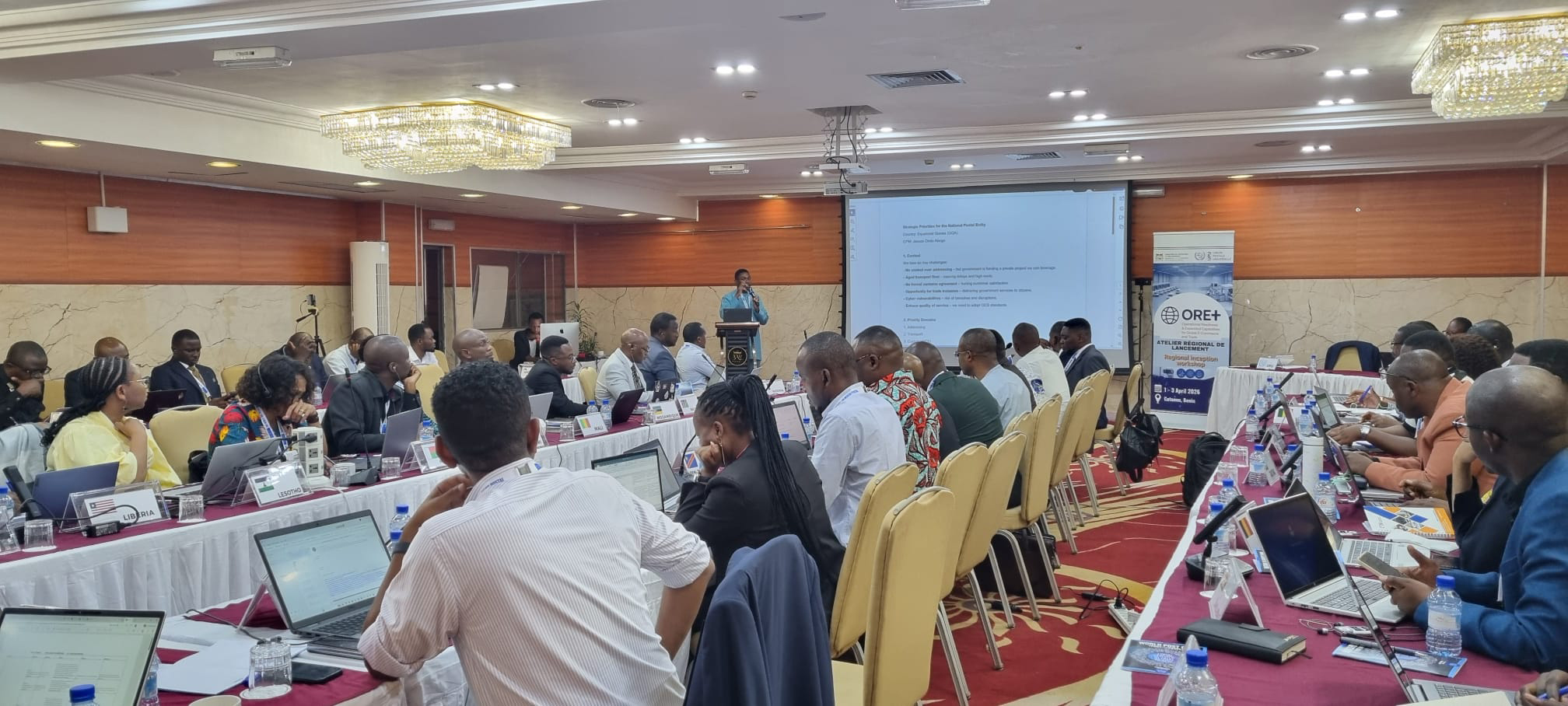
Regional inception activities for ORE Plus are already underway. In Africa, a launch workshop held in Cotonou, Benin, from 1 to 3 April 2026 brought together more than 160 participants. Country Action Plans were developed and refined during the event, aligned with the Dubai Postal Strategy 2026-2029.
The programme’s 2026 priorities are clearly defined. “Four priorities are essential: completing baseline assessments; establishing and training national ORE Plus teams; launching the first cycle of workshops and digital training; and deploying strengthened performance dashboards,” says Ellili.
Full implementation and capacity building will follow in 2027-2028, with consolidation, final evaluations, and certification targeted for 2029.
Ellili is clear about what the programme ultimately represents: “ORE Plus represents a significant advancement in the UPU’s support for global postal modernization. Its emphasis on sustainability, digital readiness, and inclusive trade positions postal operators as strategic facilitators of economic development.
“Success will rely on collaborative engagement across designated operators, regional postal unions, national authorities, and private partners, ensuring that all posts can participate fully in the evolving digital economy,” Ellili concludes.
This article first appeared in Union Postale Spring/Summer 2026.